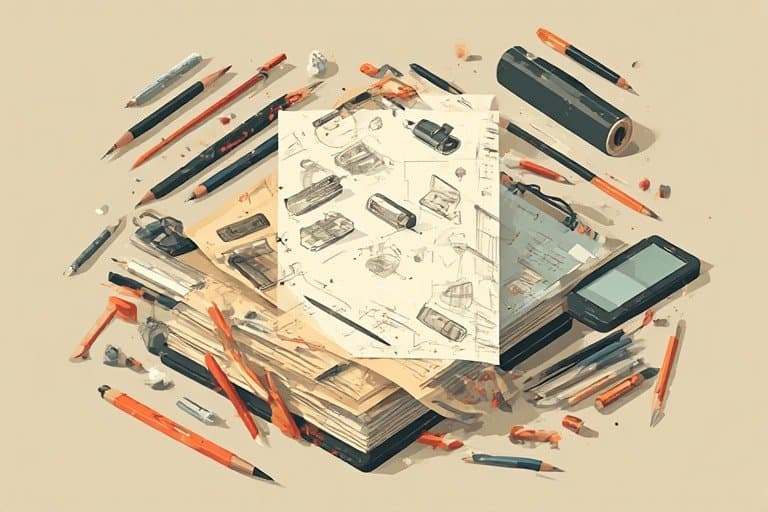
Choosing Between Pen and Pencil for Design Sketching
Design sketching demands tools that match the speed of concept development and the nuance of visual refinement. According to TIP 392, pencils excel in flexible exploration and shading, allowing designers to adjust line weight and tonal depth without committing to a permanent mark. In contrast, pens provide speed, clarity, and line confidence, delivering crisp strokes that translate well to presentation-ready drawings. The article notes that the optimal choice depends on the designer’s training and the intended outcome of the sketch. Copy from TIP 392
For early-stage ideation, many designers start with a graphite pencil to capture rapid gestures and iterative variations. When the concept solidifies, switching to a fine‑line pen can sharpen the visual language and reduce ambiguity. This workflow leverages the strengths of both media, aligning with the pros and cons outlined in the source.
Paper Selection: Cotton vs. Wood Pulp for Sketchbooks
Paper quality directly influences line quality, shading smoothness, and the longevity of a sketch. Essential Art Supplies Every Beginner Artist Needs distinguishes cotton paper as smoother and more durable, making it ideal for final presentations and archival work. Wood pulp paper, by contrast, is more affordable and suitable for practice sketches where surface texture is less critical. Copy from Essential Art Supplies Every Beginner Artist Needs
The #1 Blog on Interior Design Drawing highlights practical format choices: tiny A6 notebooks for quick location sketches and larger A4 formats for fully developed ideas. A6 sketchbooks are praised for being small, light, and magical, offering portability without sacrificing usable drawing area. A4 sketchbooks accommodate detailed interior plans and expansive compositions, providing sufficient space for annotations and layered drawings. Copy from #1 Blog on Interior Design Drawing
Top Graphite and Soft Pencils for Fashion and Interior Sketching
Graphite pencils remain a cornerstone of the designer’s toolkit. Essential Art Tools for Artists to Create Stunning Work lists graphite pencils among the top five essential tools, underscoring their versatility across disciplines. Soft pencils, especially those marketed as the softest, deliver richer tonal ranges and smoother shading, a point emphasized in Pencil for Fashion Sketching! The article advises fashion illustrators to seek the softest pencils to enhance the fluidity of garment drapery and fabric textures.
Sketching and 4 Main Types expands the sketching palette to include charcoal and black liner alongside pencils, offering designers a broader spectrum of mark‑making options. Charcoal adds deep, expressive values, while black liners provide precise, controlled lines for technical detailing. By integrating these media, designers can tailor their material choices to the specific visual language of fashion, interior, or product concepts. Copy from Sketching and 4 Main Types
Digital Tablet Options: Graphic, Display, and Tablet PCs
Digital tablets have become indispensable for designers seeking flexibility, undo capability, and seamless integration with design software. Mastering Digital Art: Essential Tips for Beginners categorizes tablets into three main types: graphic (screenless) tablets, display tablets, and tablet PCs. Graphic tablets rely on a separate monitor, offering high precision without the cost of an integrated screen. Display tablets combine drawing surface and display, allowing direct on‑screen interaction, while tablet PCs provide a self‑contained solution with built‑in operating systems.
Buying Guide: Essential Tools for Digital Artists recommends the Apple Pencil as the top digital stylus, especially when paired with the iPad, which is highlighted as the leading drawing tablet. The combination delivers pressure sensitivity, tilt recognition, and a natural hand‑held feel, meeting the demands of professional designers for both sketching and detailed illustration. Copy from Buying Guide: Essential Tools for Digital Artists
Integrated Workflow: Combining Traditional and Digital Tools
Modern design practice often blends analog and digital processes to capitalize on the strengths of each medium. Designers may begin with a soft graphite pencil on cotton paper to explore form and texture, then scan or photograph the sketch for refinement in a digital environment. The pen’s confidence and speed, as described in TIP 392, become valuable when translating concepts into vector lines or digital renderings on a display tablet.
Choosing the appropriate paper format—A6 for rapid studies or A4 for comprehensive layouts—aligns with project phases, while the selection of a high‑quality stylus such as the Apple Pencil ensures precision during the digital iteration stage. By understanding the specific advantages of pencils, paper types, and tablet technologies, designers can construct a workflow that maximizes creativity, efficiency, and final output quality. Copy from TIP 392
Conclusion
Effective sketching hinges on selecting the right tools for each stage of the design process. Pencils offer flexibility and shading depth, pens deliver speed and clarity, and paper choice influences texture and durability. Digital tablets, particularly those paired with the Apple Pencil, extend these capabilities into the digital realm, providing undo, layering, and seamless integration with design software. By aligning material choices with project goals, designers can achieve both expressive exploration and polished presentation.