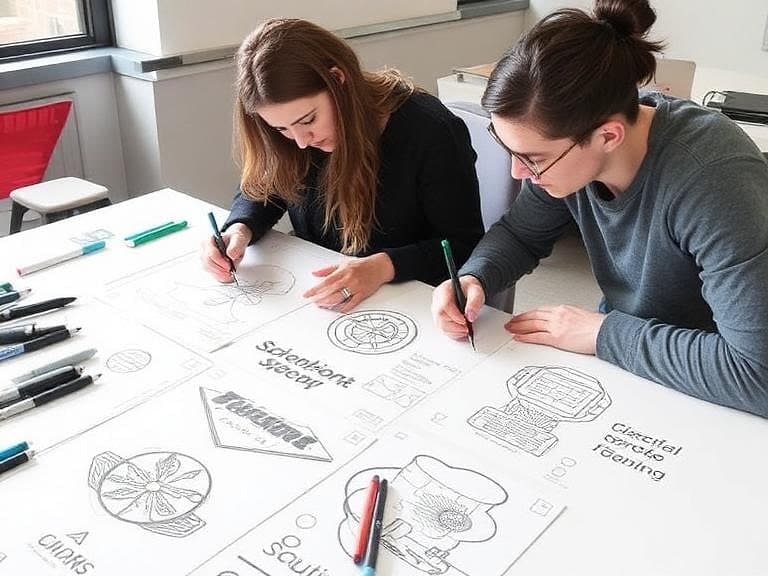
Iterative Sketching as a Foundation for Brand Ideation
Recent industry discussions emphasize that brand identity does not emerge from a single concept but from a series of intentional visual explorations.
notes that focused idea generation and collaborative ideation sessions are essential for innovation that resonates with consumers. Sketching, whether rough or refined, becomes the visual language through which those ideas are communicated. The process of drawing line, curve, and shape translates abstract brand values into tangible symbols that can be evaluated, critiqued, and improved.
In practice, the iterative nature of sketching allows designers to test multiple directions before committing to a final mark. Each sketch serves as a hypothesis about how a brand will be perceived, and the subsequent feedback loop determines whether the hypothesis aligns with strategic goals. By treating sketches as experimental data points, teams can retain flexibility while moving toward a cohesive identity.
Workshop Structures: Aligning Teams Through In-Person and Remote Sessions
Running a branding workshop, whether physically together or via digital platforms, is highlighted as a critical step for aligning stakeholders.
explains that workshops provide a solid foundation for brand building, enabling participants to develop a consistent brand identity for a client or internal business. The same source stresses that remote workshops can achieve parity with in‑person sessions when structured with clear agendas, shared digital sketching tools, and real‑time feedback mechanisms.
Key components of an effective workshop include:
Pre‑work assignments that gather existing brand assets and market insights.
Facilitated sketching rounds where each participant contributes visual concepts.
Structured critique phases that prioritize strategic alignment over aesthetic preference.
Documentation of iteration outcomes to inform subsequent design phases.
These elements ensure that the team remains on a single page, as described in
Copy from How to Run a Brand Identity Workshop That Works
, which underscores the importance of defining core values and crafting a unique brand that resonates with the audience.
Sketching Techniques that Strengthen Brand Consistency
Technical guidance on sketching reinforces the need for purposeful line work.
highlights that every line, curve, and shape is a step toward a visually compelling idea that resonates with brand identity. It recommends a disciplined approach: start with construction lines and vanishing points to establish perspective, then apply bolder strokes rather than numerous small marks. Shadows and contour lines add depth, helping viewers understand surface changes and radii.
Practical tips from a community discussion,
advise designers to use construction lines, apply vanishing points for accurate perspective, and employ bold pen or pencil strokes to convey confidence. Adding shadows and contour lines further clarifies three‑dimensional intent, which is particularly valuable when translating sketches into vectorized logos.
Iterative refinement is also supported by typographic experimentation.
notes that typographic compositions emerge through exploration, iteration, and refinement, requiring dozens of sketches before a final composition is selected. This iterative mindset mirrors the broader brand identity process, where visual and verbal elements co‑evolve.
Scaling Brands Through Iterative Design Thinking
Long‑term brand scalability depends on a disciplined iterative process.
describes a case where a single mark was expanded into a fully formed identity through exploration, feedback, and iterative refinement with the brand owner. The resulting identity proved authoritative and adaptable across contexts ranging from confidential briefings to public communications.
Design thinking workshops that incorporate drawing further illustrate the cognitive benefits of sketching.
explains that participants actively draw architectural elements, materials, and concepts, which accelerates idea generation and clarifies design intent. By integrating sketching into the broader design thinking framework, teams can maintain clarity, speed, and confidence throughout the brand development cycle.
These documented approaches collectively demonstrate that iterative sketching is not a peripheral activity but a core methodology for building, testing, and scaling brand identity. The repeated cycle of sketch, critique, and refine ensures that visual symbols remain aligned with strategic objectives and can evolve as market conditions change.
Conclusion: Institutionalizing Iteration for Durable Brand Identity
Across multiple sources, the consensus is clear: iterative sketching sessions provide a structured pathway from abstract brand values to concrete visual systems. By embedding sketching into workshops—whether in‑person or remote—designers capture diverse perspectives early, apply disciplined visual techniques, and refine concepts through feedback loops. The result is a brand identity that is both authentic to its origins and flexible enough to support future growth.
Organizations seeking to strengthen their brand should therefore institutionalize iterative sketching as a standard phase of the branding process, ensuring that every line drawn contributes to a cohesive, scalable, and resonant identity.