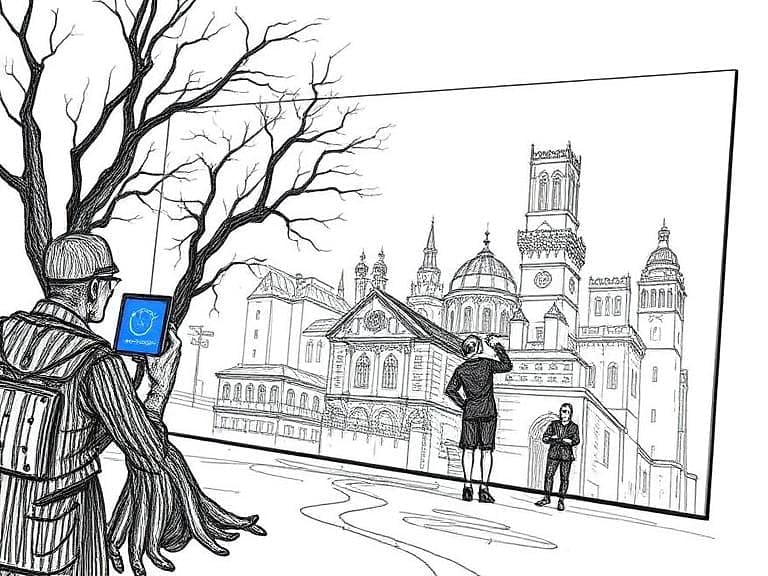
Advances in AI‑Assisted Sketching: Recent Research Findings
Academic research at Stanford has produced open‑source AI models that let artists steer outputs more precisely, turning the technology into a collaborative partner rather than an autonomous creator. The team’s goal is to augment visual storytelling, offering creators of any skill level a way to translate ideas into sketch concepts faster. This approach emphasizes guidance over automation, positioning AI as a catalyst for human imagination.
Copy from Stanford Report
Industry experts echo this shift. Shantanu Pandey, founder of Tenet, notes that AI has moved digital artistry from pure execution to creative direction. Artists now spend more time deciding what to create and less on repetitive rendering, a change that reshapes the entire workflow.
Copy from "How AI changed digital artistry in 2026 | Expert insights"
Key AI Tools Shaping Sketch Workflows in 2026
Several commercial and open platforms dominate the sketch‑assistance landscape. Midjourney, Dream, and Artbreeder serve as rapid ideation engines, generating visual prompts that artists refine by hand. Adobe’s Firefly suite remains a leader, offering smarter prompts, Photoshop integration, and realistic style‑matching that let users generate entire compositions or apply one‑click refinements without leaving familiar tools. Canva’s Magic Studio acts as a personal assistant, handling background removal and compositional expansion in seconds.
Copy from INSIDEA
Copy from Designe‑R
Copy from "10 AI Tools Every Designer Should Try in 2026"
Open‑source initiatives highlighted by Stanford provide a transparent alternative, enabling developers to embed custom control layers that respect an artist’s intent. These tools can be combined with commercial solutions to create a hybrid environment where proprietary speed meets community‑driven flexibility.
Copy from Stanford Report
Practical Techniques for Integrating AI Without Losing Authorship
Effective integration begins with ideation. Artists input high‑level concepts into AI generators, then select the most promising outputs as a springboard for manual refinement. This process maintains the creator’s voice while exploiting AI’s ability to produce unexpected visual starting points. According to IntelligentHQ, such assistance helps overcome creative blocks by proposing directions that may not have emerged through traditional brainstorming.
Copy from IntelligentHQ
Technical assistance is another pragmatic layer. AI can automatically generate perspective grids, enforce symmetry, and suggest proportion corrections, freeing the artist to focus on expressive decisions. The Creative Staffing & Recruiting Agency guide emphasizes that these functions reduce the time spent on routine tasks, allowing more iterations of composition and color scheme within a single session.
Copy from "From Sketch to AI Masterpiece"
For collaborative projects, INAIRSPACE reports that AI can produce quick visual sketches based on brief prompts, presenting multiple style and mood options to stakeholders early. This early visualization reduces misalignment later in the design process and streamlines client feedback cycles.
Copy from INAIRSPACE
Impact on Professional Practice and Creative Decision‑Making
Design teams now use AI to generate variations for A/B testing, a practice highlighted by IntelligentHQ as essential for client presentations. By offering several plausible visual directions instantly, designers can explore a broader design space without proportional increases in labor. The result is a higher likelihood of selecting a concept that resonates with target audiences.
Copy from IntelligentHQ
Adobe Firefly’s generative fill feature, described by Designe‑R, demonstrates how AI can be embedded directly into existing workflows. Artists can expand a canvas, replace backgrounds, or adjust lighting with a single command, all while retaining full control over the final output. This seamless integration encourages adoption among professionals who might otherwise resist separate, disconnected tools.
Copy from Designe‑R
According to the Best AI Tools ranking, the most useful platforms combine ease of use with the ability to preserve a creator’s unique style. Tools that allow fine‑tuned prompts, style‑matching, and iterative refinement are consistently rated higher, underscoring the industry’s preference for augmentation over automation.
Copy from "Best AI Tools for Creativity in 2026 — Ranked and Reviewed"
Summary and Outlook
Across academia and industry, 2026 marks a clear consensus: AI‑assisted sketching tools are designed to enhance, not replace, human creativity. Open‑source models give artists granular control, while commercial suites like Adobe Firefly and Canva provide speed and integration. By leveraging AI for ideation, technical assistance, and rapid variation, creators retain authorship while benefiting from computational power. The continued evolution of these tools promises deeper synergy, where the artist’s intuition guides AI output, leading to richer, more efficient creative outcomes.
Copy from Stanford Report